
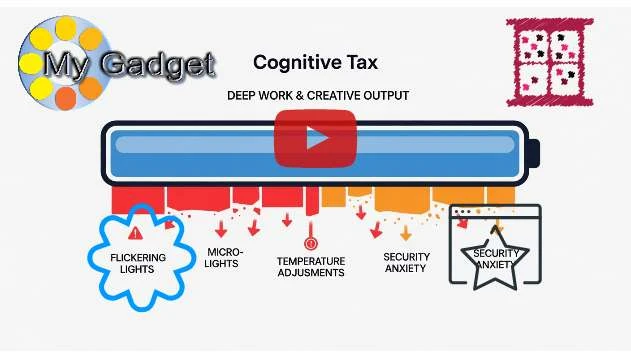
Just like background applications drain a computer’s RAM, everyday micro-inconveniences consume your mental bandwidth, leaving less capacity for deep, meaningful work.
Everyday life is often described as a series of grand choices, but for the high-functioning individual, reality is far more granular.
It is composed of a thousand micro-inconveniences—the flickering light that demands manual attention, the persistent anxiety about an unlocked door, or the physical strain of an poorly adjusted workspace.
These small friction points impose a hidden “cognitive tax,” silently draining your executive function and reducing your capacity for deep, meaningful work.
By treating your environment as a system to be optimized rather than a backdrop to be endured, you can reclaim significant mental bandwidth.
The Cognitive Tax: Why “Micro-Inconveniences” Drain Your Productivity
Understanding Cognitive Friction and the Entropy of Daily Life

Cognitive friction is the silent adversary of peak performance.
Just as a computer slows down when its background processes consume too much RAM, the human brain suffers from “context switching” when faced with constant, minor environmental interruptions.
Every time you are forced to pause a train of thought to address a physical nuisance, you experience a “switching cost.
” Over a single day, this entropy accumulates, leading to a state of mental exhaustion that is often misidentified as simple laziness or lack of willpower.
The “Personal Operating System” Approach to Gadget Selection
To mitigate this, you must adopt a “personal operating system” mindset.
This involves viewing every item in your living and working space as either a functional component that supports your goals or as “bloatware” that hinders them.
When selecting gadgets, do not ask if an item is fashionable or novel.
Instead, ask if it effectively automates a repetitive decision.
A tool should be a silent, reliable extension of your intentions, disappearing into the background of your life once it is installed.
Why High-IQ Workflows Require Lowering Mundane Decision Fatigue
Individuals who engage in complex problem-solving require a pristine cognitive environment.
High-IQ workflows demand intense, sustained focus.
When your mind is cluttered with the status of household infrastructure—temperature, security, or lighting—your subconscious constantly allocates cycles to monitor these variables.
By automating the mundane, you essentially offload these background tasks to a robust, digital infrastructure, leaving your primary processor free to focus on abstract thought and creative output.
Reducing Mental Load: The Digital Concierge and Smart Automation
Voice-Controlled Lighting: Eliminating the “Light Switch Hunt”
The simple act of walking into a dark room and fumbling for a switch is a minor, yet persistent, rupture in one’s mental flow.
Voice-controlled lighting, integrated with a central hub, transforms this mundane physical task into a frictionless experience.
By issuing a simple command, the environment adapts to your needs instantly.
This is not merely about convenience; it is about maintaining a state of immersion, allowing you to move through your home without the mental interruption of manual hardware adjustment.
Smart Hubs and Sensors: Solving the “Did I Lock the Door?” Anxiety
We have all experienced the “doorbell uncertainty” loop—that nagging thought while driving to work or drifting off to sleep regarding whether a door was locked or a window closed.
Smart home sensors and automated locks provide a real-time, authoritative status report.
Through a secure interface, you can verify your home’s integrity in seconds.
This eliminates the “loop” of repetitive worry, allowing you to reallocate that mental energy to your current task.
Smart Mirrors and Displays: Streamlining Morning Information Overload
The morning hours often suffer from an influx of fragmented information: weather reports, calendar alerts, and communication notifications.
Smart displays, acting as a central dashboard, aggregate this data into a coherent format.
By presenting essential information at a glance, these devices prevent the “phone scrolling” habit that frequently leads to distraction before the day has even truly begun.
Automating Household Coordination with Gemini and Google Home
Modern smart home ecosystems, powered by advanced AI, function as a digital concierge.
Tools like Google Assistant and Gemini act as the glue between disparate systems.
Whether it is coordinating a family calendar, setting climate automation, or managing communication channels, these tools synchronize the home.
This automation ensures that coordination is handled by software, preventing the friction that arises when humans are forced to negotiate or monitor household logistics manually.
The Ergonomics of Efficiency: Insights from High-Stakes Radiology
The Precision of the Vertical Mouse: Reducing Wrist Strain in Deep Work
In fields like radiology, where professionals spend hours reviewing intricate data, ergonomic precision is a matter of career longevity.
The vertical mouse is an essential tool for any knowledge worker.
By aligning the wrist in a neutral “handshake” position, it drastically reduces repetitive strain.
When your body is comfortable, your brain stays in the flow state longer.
If you are physically “stuck” due to discomfort, your capacity for complex thought suffers immediately.
Hotkey Efficiency: Using Programmable Buttons to Offload Repetitive Tasks
Every mouse click is a micro-decision.
By utilizing programmable macro buttons or external “stream decks,” you can reduce these clicks to a single input.
Whether it is launching a specific application, toggling a muted microphone, or executing a complex script, these buttons minimize the “stuck” feeling of navigating menus.
It is an investment in speed that compounds over months of labor.
Monitor Arms and Medical-Grade Positioning: Solving Chronic Neck Fatigue
Screen fatigue is often a result of poor geometry.
Using medical-grade monitor arms allows for precise, fluid adjustment of your visual field.
When your display is positioned at the perfect height and depth, you stop fighting your own skeleton.
This physical alignment allows for longer periods of sustained attention, effectively increasing your productive work hours without increasing the physical toll.
The Shotgun Microphone Solution: Clear Communication Without Headset Fatigue
Headset fatigue is a common byproduct of the modern professional’s relationship with remote meetings.
Constant pressure on the ears and the feeling of being “tethered” to a computer can act as a persistent irritant.
A high-quality shotgun microphone setup, positioned off-camera, provides studio-grade clarity while liberating the user from wearing hardware.
This facilitates more natural, less strained communication.
Tactical Minimalism: The “CIA Case Officer” Approach to Everyday Carry (EDC)
Reliability Over Novelty: Why the Casio F-91W Remains a Gold Standard
The Casio F-91W remains the gold standard in timekeeping not because of its features, but because of its unwavering reliability.
It is a tool that never asks for your attention—no charging, no updates, no screen interaction.
It performs one task perfectly.
In an era of constant notifications, the “watch” as a simple, reliable instrument is a masterclass in minimalism.
“Cover for Action”: Choosing Gadgets That Blend into Any Environment
When selecting gear, prioritize “low-profile” aesthetics.
Gadgets should not broadcast their utility; they should blend into your environment.
This principle, often used in field work, ensures that your tools remain secondary to your actions.
A device that looks “tactical” or “high-tech” often distracts from the goal; a device that looks ordinary is consistently more effective.
The High-Lumen Pocket Flashlight: A Simple Solution for Low-Light Friction
A compact, high-output flashlight is an essential problem-solver.
Whether it is navigating a dark basement or inspecting a faulty connection behind a desk, the ability to illuminate your environment instantly removes a major source of physical frustration.
It is the definition of “being prepared” for the minor, unforeseen obstacles of daily life.
Discreet Multi-Tools: Solving Physical Obstacles Without the Bulk
Physical obstacles frequently interrupt momentum—a loose screw, a trapped wire, or a stubborn package.
A minimalist, high-quality multi-tool allows you to resolve these issues on the spot.
By keeping the bulk to a minimum, you ensure that you actually carry the tool, turning “impossible” physical hurdles into quick, five-second fixes.
Active Cognitive State Management: Movement as a Productivity Tool
The Walking Desk: Solving the Sedentary Brain Fog
Sedentary behavior is the enemy of cognitive agility.
When the body remains stagnant for hours, the mind follows suit, becoming “stuck” in a cycle of diminishing returns.
A walking desk allows for low-intensity movement that keeps the blood flowing and the brain engaged.
It is a powerful tool for preventing the mid-afternoon slump.
Active Seating and Unstructured Movement: Keeping the Mind “Stuck” in Flow
Standard chairs often force the body into static, unhealthy postures.
Active seating options—such as balance stools or kneeling chairs—encourage micro-movements throughout the day.
These shifts prevent the physical stiffness that signals to the brain that it is time to quit.
By maintaining a body in motion, you sustain the focus required for high-order work.
Wearable Tech for Stress Regulation: Identifying Friction Before Burnout
Wearables that track heart rate variability and stress levels provide an objective data point for your internal state.
They act as a diagnostic, identifying when environmental or task-based friction is pushing you toward burnout.
This data allows for proactive intervention—taking a break or switching tasks before the mental exhaustion becomes total.
Mastering Information Entropy: Gadgets for Knowledge Workers
Dedicated E-Readers: Creating a Distraction-Free “Library” Environment
A dedicated e-reader is a fortress for the mind.
Unlike tablets, which are designed to keep you connected and distracted, an e-reader is for singular consumption.
It creates a private library that is free from the reach of the internet, allowing for deep reading that is essential for intellectual growth and the synthesis of new ideas.
Smart Note-Taking Tablets: Bridging the Gap Between Tangible Thought and Digital Filing
The tactile act of writing by hand is scientifically linked to better cognitive processing.
Smart tablets that replicate the paper experience while allowing for instant digital search and organization provide the best of both worlds.
They capture your thoughts as they happen, ensuring that ideas are never lost to the entropy of scattered notebooks.
Noise-Canceling Ecosystems: Protecting the “Minds” of Profoundly Gifted Students
Profoundly gifted thinkers are often highly sensitive to sensory input.
Noise-canceling headphones are not just for listening to music; they are tools for creating a controlled environment.
By shielding the senses from environmental noise, you protect your “inner library” of thoughts, allowing for intense, concentrated output in environments that would otherwise be overwhelming.
The “Invisible” Home: Smart Infrastructure for Hidden Peace of Mind
Smart Thermostats: Eliminating Temperature Conflict and Climate Micro-Adjustments
Temperature is one of the most common, yet least discussed, sources of friction.
A smart thermostat that learns your preferences removes the need to negotiate with your own environment.
By automatically regulating the temperature, it ensures your home is always in a state of “unnoticed comfort,” removing the distraction of feeling too hot or too cold.
Conclusion
The pursuit of an optimized lifestyle is not about accumulating more gear; it is about refining your environment until it is so frictionless that it becomes invisible.
By implementing smart automation, prioritizing ergonomic precision, and adopting a tactical approach to your everyday carry, you effectively outsource the management of your surroundings.
This shift in methodology allows you to redirect your most valuable asset—your cognitive bandwidth—toward higher-order thinking, creativity, and meaningful productivity.
Start by identifying the three most persistent micro-inconveniences in your day, and replace them with reliable, low-maintenance solutions.
You will find that when your physical environment stops demanding your attention, your mind is finally free to solve the problems that truly matter.
